

07 Oct 2001 - PM Chrétien announces that Canada will join the US forces in Afghanistan
Canada joins war on Afghanistan
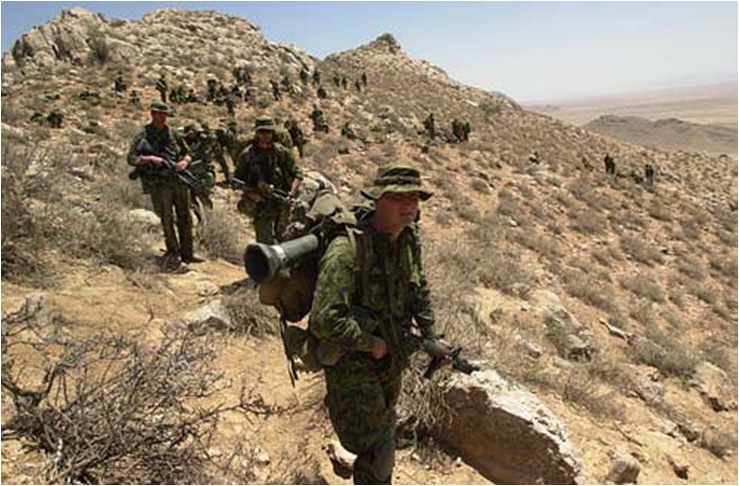
Canadian soldiers from 3PPCLI move into the hills to search for Al Qaeda and Taliban fighters. These soldiers are participating in Operation Cherokee Sky in support of Operation Enduring Freedom. (Credit: Staff Sgt. Robert Hyatt, USA, July 2002)
For thirty-five years, from the 1956 Suez Crisis to the end of the Cold War, Canada was recognized for being a “peace-keeper” and pacific nation. This would change following the terrorist attacks on the United States on 11 September 2001. The United Nations Security Council adopted Resolution 1368 condemning the attacks and supporting international efforts to root out terrorism in Afghanistan. The day after the attack, Canadian Prime Minister Jean Chrétien telephoned United States president George W. Bush to pledge “Canada’s complete support” for the Americans. The exact nature of this commitment became clear in October: Canada would take part in a US-led multinational campaign to invade Afghanistan.
On 7 October 2001, the United States and the United Kingdom launched Operation Enduring Freedom to dismantle the Al-Qaeda terrorist network in Afghanistan and to remove the Taliban regime from power. On the same day, Canadian Prime Minister Jean Chrétien, announced that Canada would contribute air, land and sea forces to the international campaign against terrorism. Canada entered the international mission, with its contribution to the campaign: OP APOLLO.
The Canadian troops dispatched to the Afghan war were sent on a six-month tour of duty. Canada’s military’s Chief of Staff, General Ray Hénault, did not place any limit on either the duration or the size of the Canadian commitment: “The operation is going to be a long military and diplomatic and political operation, one in which there is no clear end date... We do know that we will contribute to them as long as it is required.” Canada would be in Afghanistan for another 13 years, til 2014; making the Afghan war Canada’s longest war and its first significant combat engagement since the Korean War (1950-53).
We spoke with Maj Fred Wolanski, who was the Battery Commander for the 3 PPCLI Battle Group. In his words, the concept of going to war, after years of peacekeeping or moderate conflict such as Cypress and Bosnia, was noticeably foreign to the troops. It was also quite a surprise that a Liberal government would send Canadians to war. He attests, “When we got the direction to deploy, our soldiers were in a bit of a shock. They were wondering when we would be back, or even have leave. My answer was - we are going to war guys. This is not Cypress or Bosnia. We will stay there til our mission is completed. On top of that, we had to convert to mortars 81mm as we deployed without our M777s. We had November and December to train and adapt to mortars. We had til Christmas 2001.”
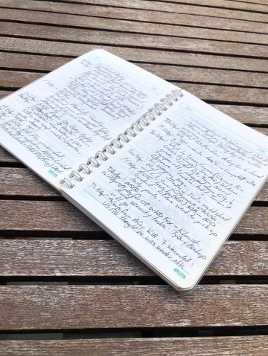
Photo of Maj Fred Wolanski’s OP APOLLO Diary - courtesy of Fred Wolanski
This commitment included more than military means. The Canadian effort was to engage diplomats, development workers, police officers, and experts in human rights. Other Canadian government departments, such as the Department of Foreign Affairs, Trade and Development Canada; the Royal Canadian Mounted Police; Canadian civilian police departments; Public Safety and Correctional Services Canada; would assemble a team that would have the difficult task of rebuilding a nation.
Canada’s contribution announced by Chrétien constituted the third largest national contingent in the six-member military coalition that was waging war on Afghanistan. Despite the relatively small strength of the contingent, it represented nearly one-third of the country’s naval fleet and was the largest combat force Canada had sent abroad since the Korean War.
Land. A few dozen Canadian Special Forces soldiers (JTF2) participated in the Dec 2001 invasion. They were followed in February 2002 by the first elements of the Canadian Battalion Group based on 3 Princess Patricia’s Canadian Light Infantry. Once the 3 PPCLI arrived in Afghanistan, they became an integral part of the 187th Brigade Combat Team of the United States 101st Airborne Division. Working alongside their American counterparts, Canadians fought the insurgency to repel them from their strongholds, eliminate terrorist operations and establish the basis for lasting peace in the troubled country. Wolanski adds, “our battery joined the 2-187 Rakkasan Squadron (part of 101st Airborne Division). We felt welcomed right away. The Americans were happy to be joined by Canadians. Two weeks after our arrival (we arrived on the 7th of February), Kandahar airfield was under constant attack. It became clear that there was a need for locating artillery.” Maj Wolanski dusted off his notes from his Instructor in Gunnery (IG) course (1994), and set to figuring it out. Using 8 inches tent pegs, 5-50 cord and a compass, he and his NCOs were able to use back-bearings to pinpoint and identify possible launch sites; these rudimentary means had become a forgotten art. He was right! His old-school crater analysis had worked. They identified 107mm Chinese rockets, pointed at the airfield, and rigged for ignition with electric wires and car batteries. He continues by saying, “it was clear to all in the battle group that Canadians had deployed with out-of-date equipment and gear.” In his opinion, this deployment was a ‘huge wake-up call’ for the army with respect to close-in fire support, and force protection writ large. Thankfully, the following years ushered in many rapid improvements for the field force.
Sea. Canada was also the first coalition nation after the United States to send maritime support. It was Canada’s largest naval commitment since the Second World War. Royal Canadian Navy (RCN) ships were sent to the Arabian Sea and the Persian Gulf with the principal task of maintaining control of the maritime area of operations. A maritime helicopter detachment also accompanied RCN ships to support Canadian and coalition operations at sea. The naval task group rapidly reached its peak in January 2002 with six warships and 1,500 personnel deployed. Canada even led a multinational task group of coalition ships in the Gulf of Oman, which included, at various times, 16 ships and several aircraft from eight different countries. This task was assigned in February 2002.
Air. Meanwhile, the Royal Canadian Air Force (RCAF) deployed a Strategic Airlift Detachment (SAL Det) in November 2001, followed by a Long-Range Patrol Detachment (LRP Det) and a Tactical Airlift Detachment (TAL Det) in January 2002. From 2001 to 2003, RCAF deployments carried more than 3.4 million kilograms of cargo, transported 2,300 passengers and logged over 4,300 flying hours.
Canada’s participation would also strengthen its geo-political influence. “If you want to play a role in the world,” declared Foreign Minister John Manley back in October 2001, “there’s a cost to doing that.” Who knew that this cost would be more than 40,000 Canadian Armed Forces members serving in a 12-year campaign. A war that would kill 165 Canadians, 158 soldiers and 7 civilians.