
CWO (retd) S. McNabb
I would like to share a little story with you on the theme of leadership to assist you in making a clearer distinction that there is always a requirement for training.
In January of this year I was on a trip to Florida, and as I was out for a walk in a beautiful park, I noticed a dog walker, who I assumed was a professional dog walker. He was leading two packs of dogs, and each pack had four dogs, and all their leashes were connected together so the walker could manage and lead them with one handle. In each of the packs, it was clear there were some alpha personalities as well as some distracted members who were just along for the ride. However, they all responded well to the walker’s direction. After reaching a point in the park, far from anyone and off any pathways, the dog walker bravely and boldly let go of the common handle to both sets of dogs. All leashes were still connected together for both packs. At that point, even though I was about 100m away, I stopped in my tracks because I thought I was going to be either tackled or I was about to witness a chase scene around the park, but to my surprise, nothing like that happened with either of the packs. Each dog had a different idea of where the pack should go, and what they should do, and after they pulled in all different directions for a what seemed was an hour, and never making any significant progress, the two packs tired. They were at a stand still, a lack of progress to advance in any direction from either pack.
 We know from our line of work that without the concept of skilled leadership built into at every level, be it at the brigade level all the way down to the platoon and detachment level, independently acting participants will translate into a lack of discipline and motivation, disorganization and reduced productivity. This is a leadership model that is destined to fail every time, just like the packs of dogs in the park, who were essentially all equals who jointly accomplished nothing, other than probably getting frustrated and craving a nap. Then, when they saw an accepted leader, their dog walker, the two packs easily advanced with a purpose.
Knowing that leadership is like any other skill, that when practiced, trained and educated you will get better and stronger. You don’t halt your leadership development once you complete a course, accepting that you are good to go. Think of it as a muscle, if you go to the gym and exercise every day, your muscles will grow. But, if you don’t go to the gym and exercise, your muscles will not grow. You are capable of developing your leadership skills on your own, but it does come at a cost that you need to be willing to accept. You will need to invest time and energy to practice, train and educate.
Leaders inspire others to follow a certain path, a common goal. Leadership skills are important because human nature requires that certain people need to take charge and help others. Without leaders, it’s difficult to manage large groups of soldiers, set unified goals, and make progress. While motivation and inspiration can make leaders strong people managers, it’s their actions that ultimately drive the respect and trust needed to be effective. Knowing yourself and seeking self-improvement are life and career long endeavours. As we know, leaders are not born with everything necessary to succeed. Developing leadership skills takes time and effort, and while an understanding of weaknesses provides a person with areas they can improve. When leaders address their shortcomings, it does lead to true growth.
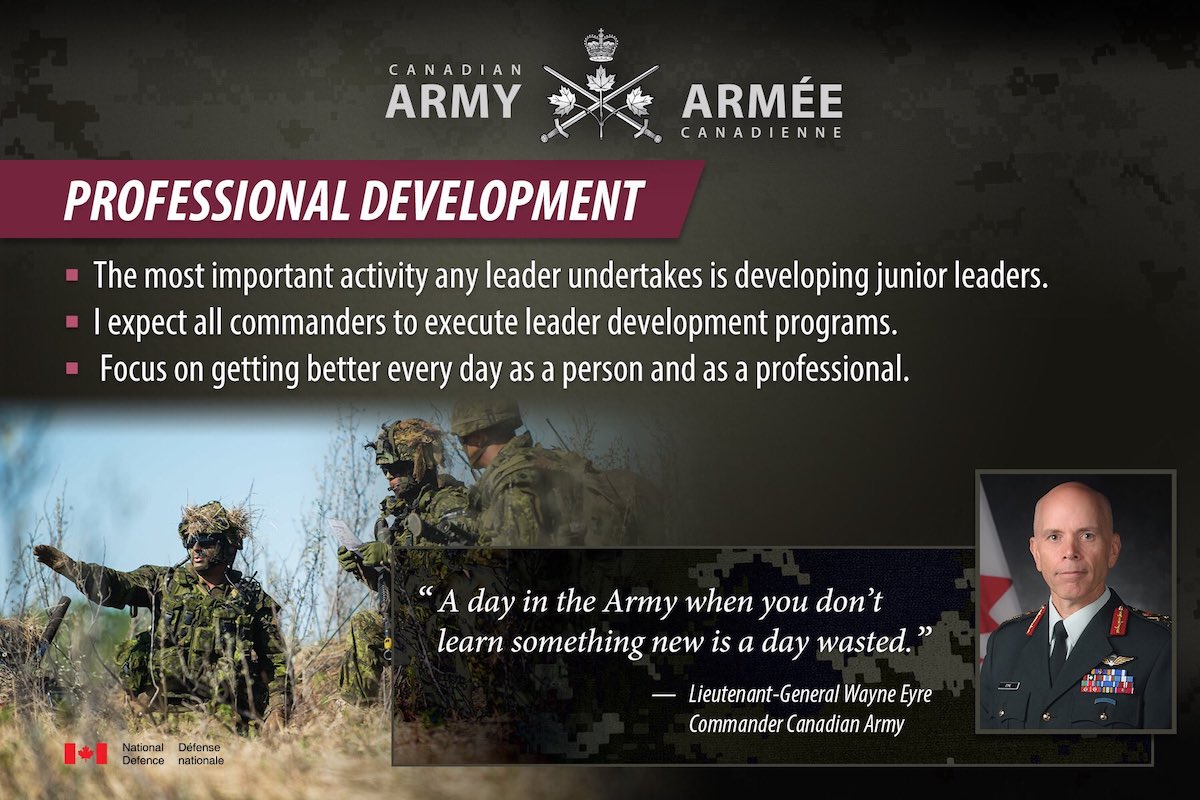
The leadership resources within a unit are endless, and can be utilized for both large and small group professional development (PD) opportunities. At the individual development level, training can be focused in on the needs of an individual. Leadership development is an evolving concept that varies along a continuously changing environment. Individuals will become better leaders when identifying a behavior that, if increased or introduced, would make a significant difference in their overall effectiveness.
It is possible to identify available courses through Royal Military College (RMC) or another educational institution that are available to meet the needs of an individual; however, an Individual Learning Plan (ILP) will need to be approved by Canadian Defence Academy (CDA) prior to submitting an Education Reimbursement (ER) for a return of the cost of the course. Another option available is to seek free online training. Below are a number of links to free online courses to help development individual leadership skills.